

“To stand still, is to fall behind” is often attributed to Mark Twain (Samuel Langhorne Clemens’ pseudonym). This is truer than ever for enterprises operating in a world that no longer follows predictable patterns. The Center for Creative Leadership (CCL) describes the macro and competitive environment as rapidly changing, unpredictable, paradoxical, and tangled (RUPT). The RUPT world makes it imperative that every enterprise evolve and transform. Transform the What, Who, When, Where and How of its sourcing & sales, production & distribution.
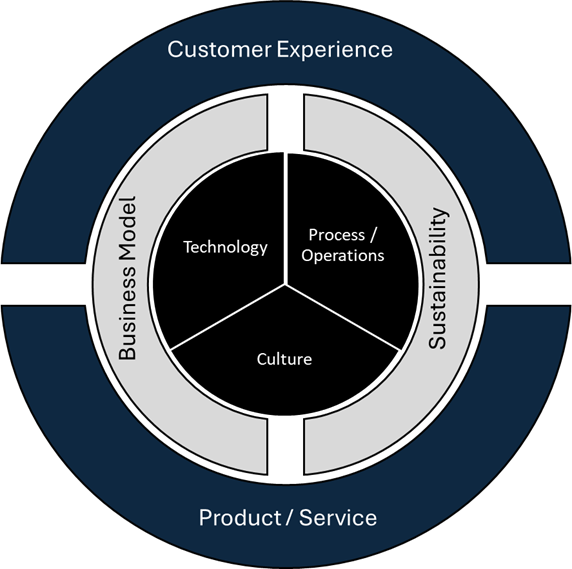
What about a WD-40, a Rolex, Levis, or a Jack Daniels, and many others who have been around for over a century, you may ask. Prima facie they have been selling the same product, or product line for eons. However, the other 3 W and H are undoubtedly transformed. Enterprises may thus undertake to transform the way their customers engage with them, or the items they buy from them. They could change their business model or sustainability commitments in delivering this experience. To do so, they typically need to transform their Process (Operations) or Technology. Most of these transformations are anchored in the culture of the organization and sometimes the culture may need be transformed before other aspects can be transformed.
In particular, digital technology and sustainability have recently become significant seductive themes for many leaders. Often so much that enterprises rush into execution without either a sustained stakeholder buy-in or a well-designed and prioritized execution plan. Such an execution may even provide considerable gains in the medium term but leave the enterprise on an unsure footing over a longer period.
However, the transformation resulting in long-term duress is not a new phenomenon. Consider GE during Jack Welch’s tenure, which expanded boldly into financial services and the media, riding on the momentum of its reputation and resources. The evolution from a manufacturing giant to an even more diverse conglomerate worked. However, as the external environment shifted, the scale and diversification made it vulnerable too. So much so that the scale and growth expectations choked its intended transformation on the back of Predix. This is a reminder of the strategic necessity of adapting to external world shifts through an agile evolution and transformation.
Figure 1: Transformation Focus areas
Enterprises may find themselves in one of the four segments, as shown in Figure 1. Those who do not demonstrate either vision or execution focus are perhaps in a stasis that may sooner than later become a crisis.
Some others may have the vision but find themselves faltering on execution. Yet others find themselves grappling with inert potential as they struggle to translate their vision into a plan. Then there are those who have the have the execution chops but lack the clarity to prioritize.
Where do you see yourself? And does your transformation journey need to start by transforming the way you see transformation?
Note: This is a sneak peek in a forthcoming book by our Managing Partner, Shyam Kerkar
Figure 2 Transformation Vision & Execution